Last month, I had the chance to attend a Microsoft-hosted tech policy event, “A Conversation on Datacenters: Who Pays for the AI Boom?” held at the Milken Center in Washington, DC. (A replay of the event can be found here.)
At the event, Microsoft Vice Chair and President Brad Smith highlighted the company’s new Community-First AI Infrastructure initiative, which includes commitments to communities with Microsoft datacenters. In addition, Rima Alaily, who heads up Microsoft’s Infrastructure Legal Affairs team, hosted a panel discussion with community leaders about how AI is benefiting their regions.
It was inspiring to hear Brad’s vision for how AI can benefit all of us. As I think about what “tomorrow” looks like, I wonder if preparing for AI starts at home—in our communities, with our friends, and with the people we see every day at work. I also think our AI future depends on teamwork, where we make progress together—a trial and error process with guardrails and security. Team members include our families, our government, our co-workers, and our schools.
Brad set the stage for discussing AI infrastructure by highlighting our nation’s history of hard work building infrastructure over the last 250 years. This includes (1) railroad tracks, (2) power grids, (3) telephone lines, (4) highways, (5) airports, and now, (6) data centers to help our country lead the future of AI.
Microsoft recognizes that its investments in data centers impact communities—and Brad laid out a plan to ensure that these impacts are beneficial. Here are the components of the plan:
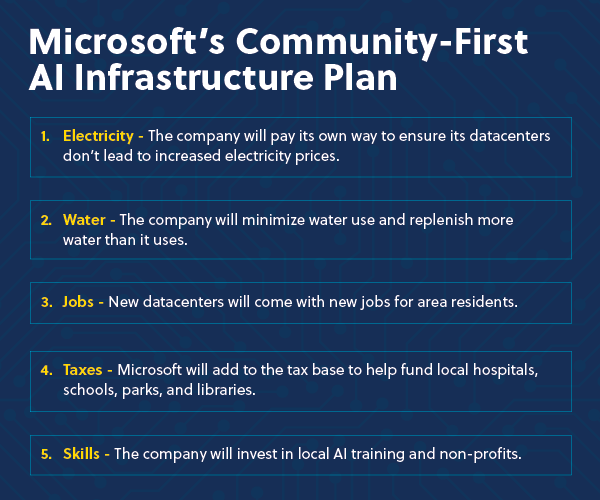
My personal opinion is that points 4 and 5 is where the magic happens. I see this as a smart, pragmatic approach—a tech leader taking steps to support communities and create a win-win situation. Essentially, Microsoft is embracing taxation because it knows that this will not just advance AI infrastructure, but will support institutions like local libraries, schools, and non-profits that can help communities learn about and benefit from AI. This is part of the teamwork that the AI era requires.
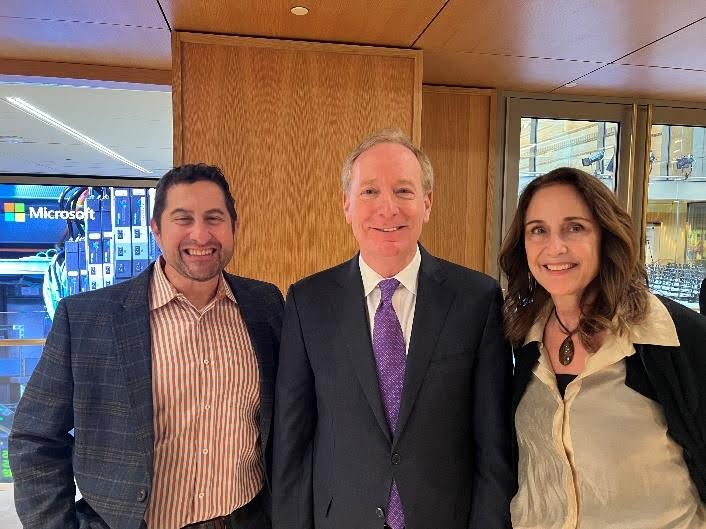
VFI Advisory Task Force leaders Ryan Risley (left) and Carol Lynn Grow (right) with Microsoft Vice Chair and President Brad Smith (center).
I got to talk briefly with Brad Smith at the event, as well as with Rima Alaily. I shared with Rima my view that it’s critical that Microsoft support AI skilling focused on knowledge workers as well as the trades. I think there is a real opportunity to support communities and expand the benefits of AI by bringing AI training opportunities to co-working spaces where knowledge workers can collaborate to accomplish more with AI.
My work changes from month to month as AI advances and my company LawToolBox incorporates AI into our offerings. I think it’s critical for those of us who understand the promises and challenges of AI to engage in critical conversations around this technology. We can help our communities, our country, and the world by helping others, including policymakers, understand and navigate the changes this technology is bringing.
For additional information, see this Microsoft on the Issues blog, “Building Community-First AI Infrastructure,” and this CNBC interview with Brad Smith.
***
Carol Lynn Grow is the COO and co-founder of LawToolBox, a legal SaaS provider based in Englewood, Colorado. She is a member of VFI’s Advisory Task Force.